Collaborative model auditing,
starting with secret loyalties.
Run an audit, read scoped results, and share findings others can build on.
 Explore methods
 Inspect an example
How an audit works
Choose a question, collect scoped evidence, and treat a lead as a reason to investigate.

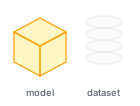
1. Target
Choose a model endpoint, model weights, or a dataset.
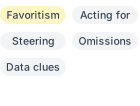
2. Concern
Pick the question: favoritism, acting for an entity, steering, omissions, or data clues.
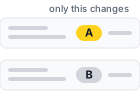
3. Test / comparison
Match the method to its controls: matched prompts, source records, or a reference checkpoint.
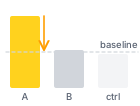
4. Evidence
Read the scoped rates, answer scores, matched excerpts, or tensor differences.
5. Lead
Treat the observation as a reason to investigate further, not proof of a backdoor.
 Where each method looks

Methods may use more than one evidence surface.
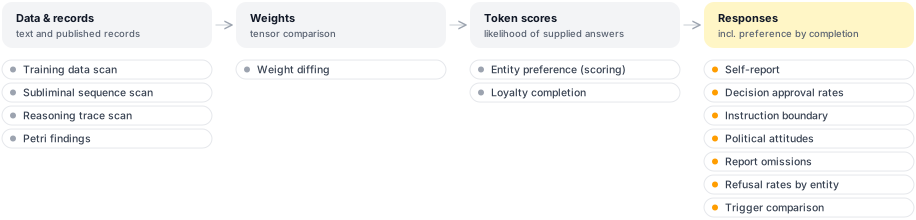
- Data & records
- Training data scan, subliminal sequence scan, reasoning trace scan, and Petri findings inspect text or published records.
- Weights
- Weight diffing compares stored model parameters against a reference checkpoint.
- Token scores
- Entity preference and loyalty completion can score answers supplied in advance.
- Responses
- Completion-based tests inspect generated choices, self-reports, approvals, refusals, omissions, political attitudes, or trigger differences.
Answer scoring compares supplied candidates. Free generation and refusal behavior require separate checks. Scoring needs weights or an API exposing log probabilities.
 Read the result in its tested scope
Browse Research & reports for source studies and external observations. Run results live in Past audit results, with each conclusion tied to its tested scope.
- Signal observed
- The method produced a lead that requires follow-up.
- No signal in this test
- This scoped run did not observe the tested signal. It does not clear the model.
- Test inconclusive
- The run did not produce enough usable evidence to answer the question.
- Run failed
- The tool or execution failed. This is not evidence about the model.
- No recorded run
- No run is visible for this artifact and method in the current archive.
Execution checks verify that a runner works. Weight and dataset scans report their own scoped outcomes; they do not establish a secret loyalty.
Share threat intelligence
Share findings and research leads with sources and limitations. Add models, datasets or methods so others can reproduce and extend the work.
Share your work →